Saddle Nose Repair
Saddle nose deformity — also called nasal dorsum collapse — is an uncommon but devastating condition that requires complex rhinoplasty or nose job reconstruction to repair. The deformity is caused by loss of structural cartilage support in the middle third of the nose, typically associated with loss or weakening of the septal cartilage that forms the central support of the nasal dorsum. In milder cases, saddle nose causes a subtle depression of the middle third of the nose, visible primarily on profile views. In more severe cases, significant collapse of the nasal dorsum produces upward rotation of the nasal tip, shortening of the overall nose, and nasal airway obstruction. Beyond the visible appearance, the deformity often causes meaningful psychological impact — self-consciousness about the visible collapse, social withdrawal, and in some patients, significant depression. For patients living with this condition, surgical reconstruction can be genuinely life-changing.
Saddle nose deformity is one of the most challenging reconstructive cases in facial plastic surgery — the surgeon must restore both the structural framework of the middle third of the nose and the breathing function that has been compromised by the collapse. Dr. Maurice Khosh’s three decades of complex nasal reconstruction include extensive experience with saddle nose repair across all etiologies. Author of “Unilateral Nasal Obstruction” in Greenwich Medical Publications and past president of the New York Facial Plastic Surgery Society, Dr. Khosh is dual board-certified by the American Board of Facial Plastic and Reconstructive Surgery and the American Board of Otolaryngology–Head and Neck Surgery. A Fellow of the American College of Surgeons (FACS), he has been recognized as a perennial Castle Connolly Top Doctor and a Best Doctors in America honoree.
What Is Saddle Nose Deformity?
Saddle nose deformity refers to the visible depression or collapse of the dorsal bridge in the middle third of the nose — the area between the bony upper third and the cartilaginous tip. The name reflects the appearance: the dorsal contour resembles the seat of a saddle, with the bony bridge above and the tip below remaining intact while the central support collapses inward. The underlying cause is loss of structural support from the septum, the upper lateral cartilages, or both:
- Mid-Nasal Vault Collapse: The middle third of the nose loses its supporting structure and falls inward
- Resulting Tip Rotation: As the bridge collapses, the nasal tip is often pulled upward into a more rotated position
- Nose Shortening: The overall length of the nose decreases as the central support is lost
- Internal Airway Compromise: The collapsing structure narrows the internal nasal valve, producing meaningful airway obstruction
Causes of Saddle Nose Deformity
Saddle nose deformity can develop from several distinct causes, and identifying the underlying cause is essential before reconstructive surgery:
- Nasal Trauma: Significant fractures or repeated traumatic injuries that damage the septal cartilage
- Previous Nasal Surgery: Most commonly when previous rhinoplasty over-resected septal cartilage, weakening the central support
- Autoimmune Disorders: Granulomatosis with Polyangiitis (formerly known as Wegener’s granulomatosis), relapsing polychondritis, and certain other autoimmune conditions can destroy septal cartilage from within
- Recreational Drug Use: Chronic intranasal use of cocaine or certain other drugs can produce septal perforation and eventual collapse
- Untreated Septal Hematoma: A collection of blood within the septum that, if not drained, can destroy the cartilage
- Infection: Severe nasal infections, including syphilis (historically) and certain other infections, can damage the septum
- Iatrogenic Causes: Other surgical or medical interventions affecting the septum
Severity Spectrum: Mild to Severe Saddle Nose
Saddle nose deformity exists on a wide spectrum from subtle to severe:
- Mild: A subtle depression of the middle third of the nose, visible primarily on profile views, with minimal functional impact
- Moderate: A more visible depression with some tip rotation and beginning airway compromise
- Severe: Pronounced collapse with significant tip rotation, visible nose shortening, and substantial breathing obstruction
- Extreme: Complete collapse with major structural loss, severe deformity, and significant breathing impairment
The reconstructive approach is tailored to the severity of the deformity — mild cases may be addressed with limited cartilage grafting, while severe cases may require extensive structural rebuilding with rib cartilage and complete framework reconstruction.
Treating the Underlying Cause First
Before reconstructive surgery, the underlying cause of the saddle nose deformity must be established and addressed — particularly for cases where the cause is ongoing rather than historical:
- Autoimmune Workup: Blood tests, biopsies, and rheumatology consultation if autoimmune disease is suspected; the underlying autoimmune condition must be under medical control before reconstruction is attempted
- Treatment of Active Disease: Patients with active Granulomatosis with Polyangiitis or relapsing polychondritis require immunosuppressive medical treatment to control the condition before considering reconstruction
- Cessation of Drug Use: Patients with recreational drug use as the underlying cause must achieve sustained cessation before reconstruction — continuing drug use would put any reconstruction at risk
- Infection Resolution: Active infection must be completely resolved before reconstruction
- Multidisciplinary Coordination: Saddle nose reconstruction often involves coordination with rheumatology, infectious disease, addiction medicine, or other specialists depending on the underlying cause
“Saddle nose deformity is one of the cases where the surgeon’s job extends well beyond the operating room. By the time a patient has visible collapse, there’s almost always a story behind it — and that story has to be understood and addressed before reconstruction can succeed. For autoimmune cases, the disease has to be controlled medically; for drug-related cases, the patient has to be in sustained recovery; for trauma cases, the patient has to be ready for what is often a multi-stage rebuilding process. The reconstruction itself is technically demanding, but the case planning starts long before the first incision.” — Dr. Maurice Khosh
Reconstructive Techniques for Saddle Nose Repair
Saddle nose reconstruction draws on several different techniques depending on the severity of the deformity, the patient’s anatomy, and the underlying cause:
- Dermal Filler (for Mild Cases): For very mild cases or as a temporary measure, hyaluronic acid filler placed in the depressed area can produce visible improvement
- Ear (Auricular) Cartilage Grafts: For moderate cases, ear cartilage harvested from the bowl of the ear provides reliable graft material for restoring the mid-nasal vault
- Rib (Costal) Cartilage Grafts: For more severe cases, rib cartilage from either the patient (autologous) or commercially prepared cadaveric tissue provides the volume and structural quality needed for major rebuilding
- Bone Grafts: For the most severe cases involving bone loss, calvarial (skull) bone grafts may be incorporated
- Manufactured Implants: Silastic or porous polyethylene implants in certain cases, though manufactured materials carry different risk profiles than the patient’s own tissue
- Open Rhinoplasty Approach: Most saddle nose reconstructions use the open approach (small columellar incision) to allow precise placement of structural grafts
- Closed Rhinoplasty in Selected Cases: For limited cases requiring minimal grafting, the closed approach may be used
The Saddle Nose Repair Consultation
The saddle nose consultation is more involved than most rhinoplasty consultations:
- Bring Pre-Collapse Photos: Patients are encouraged to bring photographs showing their nose in its healthy state before the collapse occurred — these images help guide the reconstructive plan
- Etiology Discussion: Thorough discussion of how the saddle nose developed and what underlying condition may be responsible
- Medical Coordination: Discussion of any ongoing medical conditions, medications, and other specialists involved in the patient’s care
- Computer Imaging: Visualization of potential reconstruction outcomes to facilitate communication about the goals
- Treatment Options Discussion: Review of cartilage source options (ear vs. rib vs. cadaveric), surgical approach options, and the trade-offs of each
- Realistic Outcome Expectations: Honest conversation about what is achievable for the patient’s specific deformity and what limitations may apply
- Multi-Stage Possibility: For severe cases, discussion of whether the reconstruction will be completed in a single procedure or multiple staged procedures
Why Choose Dr. Khosh for Saddle Nose Repair
- Three Decades of Complex Nasal Reconstruction: Refined experience with saddle nose repair across all severity levels and all underlying causes
- Published Research on Nasal Airway Obstruction: Author of peer-reviewed work directly relevant to the functional restoration component of saddle nose repair
- Full Range of Reconstructive Techniques: Filler, ear cartilage, rib cartilage (autologous and cadaveric), bone grafts, and manufactured implants all available
- Multidisciplinary Coordination: Established relationships with rheumatology and other specialties for cases requiring multidisciplinary care
- Honest Etiology and Outcome Discussion: Realistic conversations about underlying cause, treatment requirements, and what surgical reconstruction can achieve
- Past President NYFPSS: Recognized leadership in the New York facial plastic surgery community
- Dual Board Certification: Combined facial plastic and head and neck surgery expertise
- Park Avenue Convenience: Private Upper East Side practice serving patients from across Manhattan and the tri-state area
Schedule Your Saddle Nose Consultation in NYC
If you or a loved one is suffering from saddle nose deformity or nasal collapse, the first step is a thorough consultation that addresses both the visible deformity and the underlying cause. Contact us today to schedule a private consultation with Dr. Khosh at his Park Avenue office in New York City, or call (212) 339-9988. Patients are encouraged to bring pre-collapse photographs to help guide the reconstructive planning.
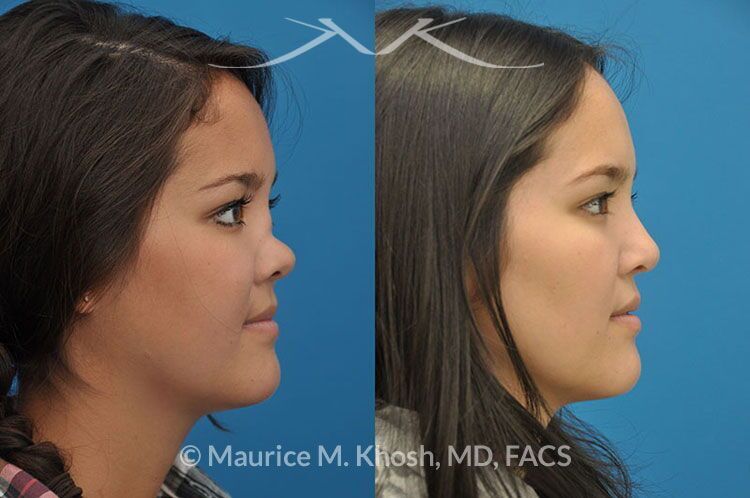
Case Study
This 17 year-old girl had developed saddle nose deformity from Wegerner’s granulomatosis. She sought consultation for repair of nasal collapse. Her nasal reconstruction entailed cartilage grafting from the rib.
- Patient: 17 year-old girl with nasal collapse
- Problem: Saddle nose deformity
- Procedure: Rib cartilage graft thorough an open rhinoplasty approach
Disclaimer: These are actual results for patients of Dr. Maurice Khosh. Plastic and cosmetic surgery results can vary between patients.
Frequently Asked Questions
-
Most insurance companies consider the surgical repair of a saddle nose deformity to be reconstructive rather than cosmetic and therefore cover the costs of surgery.
-
Currently, rib cartilage grafting is my preferred technique for repair of a saddle nose deformity. A one to two inch incision in the crease below the breast allows access for removal of a piece of rib cartilage. The incision site is closed meticulously, and the scar is barely perceptible. Pain and discomfort resolve in approximately 10 days.
-
I harvest ear cartilage through an incision behind the ear. Cartilage harvest is confined to the concave central aspect of the auricle, known as the conchal bowl and the concha symba. There will be no change to the appearance or function of the ear. The incision site is completely hidden.
-
Although each case is unique, the average duration of surgery for saddle nose deformity is 3.5 hours.
-
In surgical procedures where rib cartilage was used for repair of a saddle nose, patients typically stay in the hospital for one night. Other modalities of saddle nose repair are performed as outpatient surgeries, and patients can go home after surgery.
-
No. We do not use packing inside the nose following saddle nose repair.
-
Nasal valve collapse can be preformed via the closed (endonasal) or the open (trans-columellar) approach. Both approaches entail incisions inside the nostrils. The open approach adds an incision across the columella (the skin between the two nostrils). Open approach affords better visualization of the nasal tip cartilages and allows for precise placement of cartilages and is often preferred for nasal valve repair.
-
Normally, the septum (wall in the middle of the nose) provides supports the bridge of the nose. If the septum becomes weak due to loss of cartilage, then it can default in it’s function as supporting strut for the nasal bridge. The bridge of the nose will then sag and may eventually collapse.
-
The goal in most rhinoplasties is lowering the bridge of the nose and/or refining the appearance of the nasal tip. This is usually accomplished by shaving bone and cartilage, and using stitches to bend the nasal tip cartilages. Saddle nose repair is a more complicated reconstructive procedure. Often times, rib cartilage must be shaved into precise size and shape before placement into the bridge of then nose and the nasal tip area. Saddle nose repair requires a greater level of surgical skill and expertise.
Related Procedures
Most patients who undergo repair of saddle nose deformity are singularly concerned about the appearance of the nose. Although other cosmetic procedures such as blepharoplasty, chin implantation, or neck liposuction could be performed simultaneously, these secondary procedures are not commonly sought.

Click Here to See Saddle Nose Repair Photo Gallery